
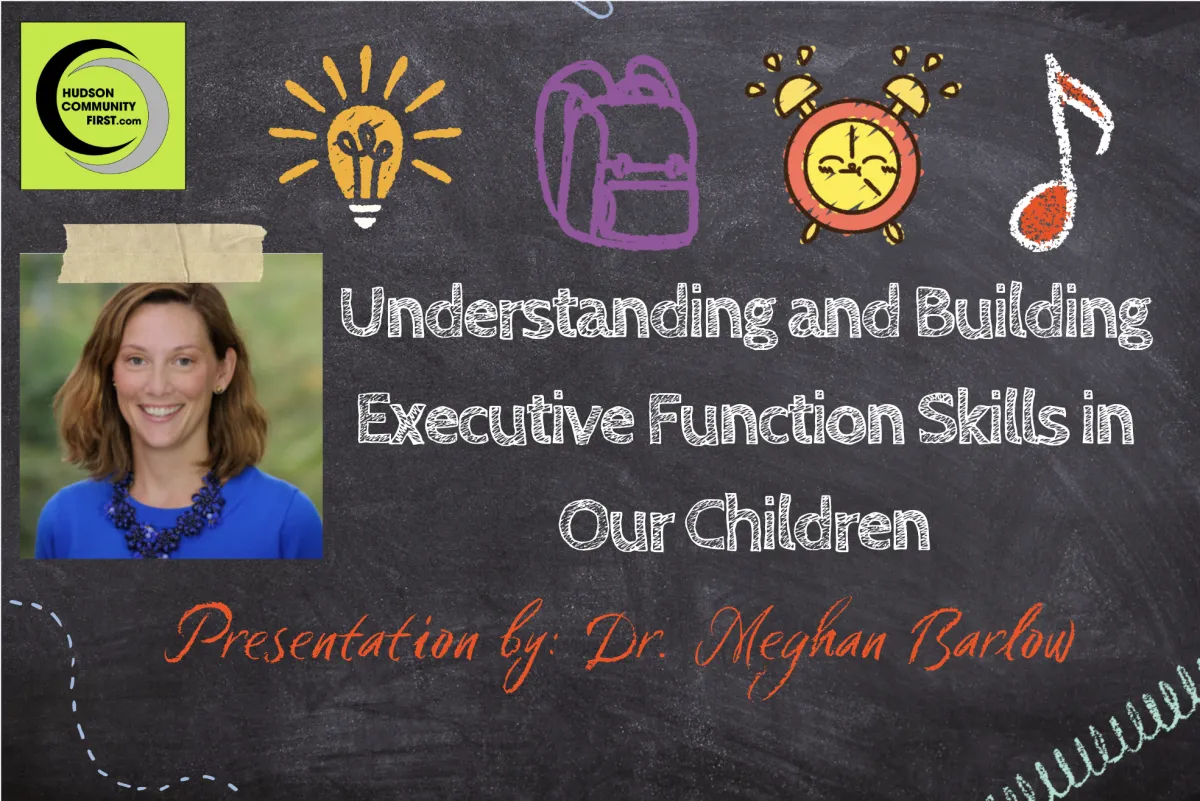
Understanding and Building EF Skills in Our Children
Understanding & Building Executive Function in Our Children
Hudson Community First – Community of Care Speaker Series
Presenter: Meghan Barlow, Ph.D. • Date: November 6, 2025 • Location: Hudson Montessori School
Dr. Meghan Barlow returned to our Community of Care series to demystify Executive Function (EF), the group of brain-based skills that help children regulate behavior, manage emotions, and complete goal-directed tasks. Rather than a single “boss,” Dr. Barlow described EF as an orchestra: distinct sections (skills) that must play together to perform the “song” (everyday tasks like waiting, getting ready, or finishing homework).
What Executive Function Includes:
Impulse Control – pausing before acting or interrupting
Working Memory – holding and using information (short- and long-term)
Emotion Control – managing feelings to stay on task and relate well to others
Self-Monitoring – noticing one’s behavior, thoughts, and impact
Planning & Prioritizing – seeing the steps and deciding what matters most
Task Initiation – moving from “I know” to “I’m doing”
Organization – keeping track of materials and information
Flexible Thinking – shifting perspectives and approaches when plans change
Dr. Barlow emphasized that EF is not a one-size-fits-all timeline. Children (and adults) have unique “wheels” of strengths and lagging areas, and these profiles interact with real-life demands at home and school. While ADHD and autism commonly involve EF challenges, EF weaknesses can occur without a diagnosis.
Why It Matters
We all use EF all day: to make friends, manage routines, solve problems, and participate in school and community life. Instead of labeling a child as having “good” or “bad” EF, families can notice which skills are strong, which need support, and how different situations amplify or strain those skills.
Growing EF Skills: Everyday Opportunities
Games & Play: card/strategy games (e.g., memory, Skip-Bo) build working memory, planning, and flexibility.
Passion Projects: tapping genuine interests (especially in MS/HS) sustains effort and task initiation.
Books & Shows: discuss characters’ choices and emotions to practice perspective-taking and problem-solving.
Modeling: narrate your thinking out loud (“First I set a timer, then I sort…”).
Habits & Routines: simple, repeatable systems beat willpower alone.
Collaborative Problem-Solving: work with your child to define the problem, brainstorm options, choose a plan, and reflect—this process strengthens all EF areas.
Practical Strategies You Can Use Tonight
Time Management (mornings/bedtime)
Visuals (picture schedules or simple comic strips)
Cues (a song, timer, or alarm to signal “what’s next”)
Plan backward, execute forward: picture the end goal, then list the steps needed now—great for all ages.
Transitions
Acknowledge the hard part: stopping a preferred activity to start a non-preferred one.
Avoid launching new tasks right before known transition crunch times.
Expect resistance, keep momentum, and coach the next step rather than getting stuck in the pushback.
Getting Started
Spark imagination: “Can you be a helper?” (identity) works better than “Can you help?” (task).
Invite the child to visualize themselves doing the first step; then act on that picture.
Tools & Resources
Book: Smart but Scattered by Peg Dawson—includes child and teen questionnaires to identify EF strengths and growth areas.
School Partnership: Ask teachers what level of parent support is appropriate for specific assignments and routines.
Fit Check: Compare your child’s EF “wheel” with your own and with your family’s realities. Where will friction show up? Where can strengths shine?

SUPPORT HUDSON YOUTH
Hudson Community First provides opportunities to make our community a place where young people thrive. We cannot do this without your support! This is all made possible through grants, private donations and our Annual Fund drive. Please consider a donation that will support programming for all Hudson students.
Because of you… Hudson is a 100 Best Community for Young People!
One-Time Donation
Support our ongoing programs
Recurring Giving
Provide sustained support for our mission.
SUPPORT HUDSON YOUTH
Hudson Community First provides opportunities to make our community a place where young people thrive. We cannot do this without your support! This is all made possible through grants, private donations and our Annual Fund drive. Please consider a donation that will support programming for all Hudson students.
Because of you… Hudson is a 100 Best Community for Young People!
One-Time Donation
Support our ongoing programs
Recurring Giving
Provide sustained support for our mission.


Connect with us and stay up-to-date!
Copyright © 2026. All rights reserved. Hudson Community First
Website by Pixel Drift Marketing