Science-Based Strategies for Raising Kids in the Complex World
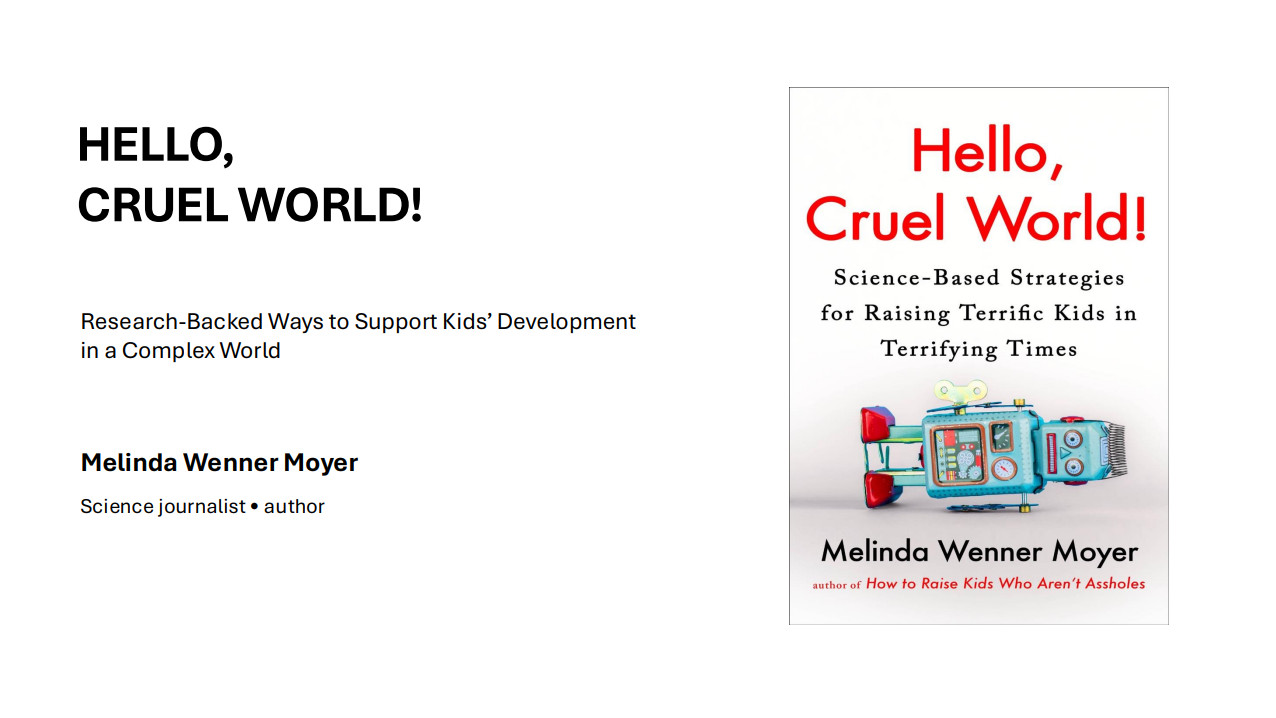
On October 5, Hudson Community First welcomed science journalist and author Melinda Wenner Moyer for the first program in this year’s Community of Care Speaker Series.
Her presentation, “Hello, Cruel World! Research-Backed Ways to Support Kids’ Development in a Complex World,” explored a question many parents know well: How do we prepare our children for a world that can sometimes feel overwhelming without trying to protect them from every difficult experience?
Moyer shared that the idea for her book grew out of questions that were keeping her awake at night as a parent. Were her children resilient enough? How could she help them become critical thinkers? Was she letting them watch too much YouTube?
Those worries are familiar to many parents today. Moyer noted that parental anxiety is high, and when we are afraid for our children, our instincts often tell us to protect more, shelter more and control more.
But that may not always be what children need.
As Moyer interviewed researchers across a wide range of fields, she began hearing remarkably similar messages about what helps children grow into capable, resilient and emotionally healthy adults. Sometimes, constructive parenting means knowing when to step in. Just as importantly, it means knowing when to step back.
Throughout the evening, Moyer organized those lessons around three simple ideas: Listen. Prepare. Comfort.
Listen More Than You Lecture
Before correcting, advising or persuading, get curious.
Moyer emphasized that one of the most powerful things parents can offer their children is the experience of truly being heard. Good listening begins with attention, but that does not always mean sitting face-to-face for a serious conversation. For some children, eye contact can feel intense. A conversation in the car, while taking a walk or while doing something together may make it easier for them to open up.
Listening also means showing that we are genuinely trying to understand. Ask follow-up questions. Reflect back what you are hearing. Resist the urge to immediately correct the facts or offer a solution.
When a child says, “Maya is mean,” instead of jumping in with advice, ask, “What did she do that felt mean?”
When they say, “My teacher hates me,” try, “What happened today that made you feel that way?”
The goal is not necessarily to agree with every interpretation. It is to communicate: Your experience matters to me. Your perspective matters.
Moyer shared research suggesting that high-quality listening can reduce defensiveness and help people become more open-minded and self-reflective. Feeling heard creates a sense of safety, and when we feel safe, we are often more willing to consider other perspectives.
That has another important implication for parents. When children share something difficult and are met with anger, panic or an immediate lecture, they may learn a lesson we never intended to teach them: Don’t tell Mom or Dad next time.
Sometimes the most productive response is simply another question.
Prepare More Than You Protect
One of Moyer’s most reassuring messages was that mental health does not mean feeling happy all the time.
Healthy children will experience disappointment, embarrassment, frustration, sadness and fear. The goal is not to eliminate those emotions, but to help children develop the skills to navigate them.
And skills require practice.
Moyer described resilience as a kind of “mastery of one’s environment.” Children cannot develop that sense of mastery without opportunities to try things for themselves, struggle a little, solve problems and discover that they can handle difficult situations.
Parents often say they want their children to become independent, yet everyday opportunities for independence can be surprisingly difficult to give them. We may answer the question for them, order their food, solve the disagreement, email the teacher or step in because doing so makes the moment easier.
But Moyer encouraged parents to ask a different question:
What will help my child become the adult I want them to be, not simply make this afternoon go more smoothly?
That might mean allowing a child to order their own meal at a restaurant, ask a teacher for help, speak to a doctor or nurse, solve a problem with a friend or complete an age-appropriate task without intervention.
Parents can also intentionally help children see themselves as brave. Notice moments when they make a brave choice. Expand their understanding of what bravery looks like. Speaking up for yourself can be brave. Walking into school when you are nervous can be brave. Asking for help can be brave.
For situations children find intimidating, role-playing at home can give them an opportunity to practice what they might say or do before they are in the moment.
For younger children, even pretend play provides powerful practice. During imaginative play, children invent rules, communicate, cooperate, solve problems, tolerate frustration and practice self-control. Those experiences help build executive-function skills including attention, planning, inhibition and flexible problem-solving.
The message was simple: We cannot build resilience for our children. We can give them opportunities to build it themselves.
Comfort More Than You Chide
When children are upset, many of us instinctively try to make the feeling disappear.
“You’re fine.”
“I’m sure he didn’t mean it.”
“Don’t worry about it.”
Moyer encouraged parents to resist the immediate urge to minimize, reassure or fix. Instead, begin by validating the emotion.
“You really wanted the red cup.”
“I can see why that upset you.”
Validation does not mean agreeing with everything a child believes, nor does it mean accepting inappropriate behavior. As Moyer put it, feelings are welcome, but not all behaviors are welcome.
The goal is to help children recognize what they are experiencing and learn that emotions, even uncomfortable ones, can be managed.
Naming feelings can itself be calming. Putting an emotion into words may help create some psychological distance from it and engage the parts of the brain involved in regulation.
Learning to recognize emotions also has benefits beyond self-regulation. Children who better understand their own feelings can become more compassionate toward what others may be experiencing.
Moyer also encouraged parents to teach self-compassion, particularly when children are disappointed in themselves.
Self-compassion does not mean making excuses or avoiding responsibility. It means responding to yourself with the same humanity you might offer a friend.
She offered three simple steps:
Notice: “This is hard. I’m feeling embarrassed.”
Normalize: “Other people struggle and make mistakes too.”
Be kind: “What would I say to a friend right now?”
Parents need that same compassion.
Children are always watching how adults respond to their own mistakes and struggles. If they constantly hear us criticizing ourselves, they may learn to do the same.
It is also healthy for children to see that adults are imperfect.
When parents make mistakes, they have an opportunity to normalize struggle, repair the relationship through sincere apology and accountability, and model what it looks like to recover, learn and move forward without becoming consumed by shame.
In fact, Moyer shared that conflict followed by healthy repair can strengthen relationships. Strong families are not families without mistakes or disagreements. They are families that know how to reconnect afterward.
Three Small Pauses
For parents trying to remember everything from the evening, Moyer offered a reassuringly simple place to begin.
In difficult parenting moments, try creating three small pauses:
1)Ask a question before offering an answer.
2)Give children time and space to try before stepping in.
3)Acknowledge what they are feeling and encourage compassion instead of criticism.
Parenting in a complex world can make it feel as though we should always be doing more to protect our children.
Moyer’s message offered another possibility.
Sometimes the most powerful thing we can do is listen closely, step back long enough for our children to discover what they can handle, and remind them that difficult feelings and imperfect moments are not signs that something has gone wrong.
They are part of growing up.
Click below to access the full presentation